.png)
Biological Assets, Cell Banking, and the New Era of Health Discrimination

In this episode of Signal Shift, Raakhee concludes her two-part exploration of the future of healthcare, focusing on the emergence of biological assets as a new global asset class. Is your DNA the next credit score?The discussion shifts from reactive healthcare to a world where our biology is measured, banked, and potentially used as a metric for societal discrimination. We explore the rise of biological age audits and how AI-powered epigenetic clocks are turning our bodies into a new asset class. From the $28 billion explosion of stem cell banking to the terrifying potential for "biological discrimination" in hiring and insurance, we discuss why your health is now your most important investment portfolio.
The Rise of Biological Assets
The focus of wellness is shifting from basic metrics like calories and BMI to biological age audits that measure physical wear and tear and aging speed.
Measurable Baselines: Biological age is becoming a measurable baseline to track performance, similar to a credit score.
Epigenetic Tracking: AI-driven "epigenetic clocks" now use DNA methylation to monitor biological aging through continuous longitudinal tracking of sleep, nutrition, and stress.
The Score as Currency: A poor biological score—such as a biological age of 45 in a 35-year-old—could eventually impact health insurance premiums, job opportunities, and even lease agreements.
New Forms of Discrimination: Raakhee suggests that future "wellness clubs" or even airlines might use these health scores to deny entry or services to those deemed a "high risk".
Biological Banking: Bio-Insurance for the Future
The conversation highlights a major shift toward preserving young biological material to ensure future health.
Exploding Market: The global stem cell banking market is projected to reach $28 billion by 2035.
"Strategic Reserves": Families are increasingly banking "day zero" cells—such as stem cells from preserved wisdom teeth—as a form of bio-insurance.
Preventative Use: These assets are banked while individuals are healthy to serve as a reserve against future age-related decline, autism, or cerebral palsy.
Health as an Investment Portfolio
Raakhee encourages listeners to view their personal health not merely as the absence of disease, but as a critical investment portfolio.
Optimization: Critical drivers of this portfolio include stress reduction, movement, and sleep.
Monitoring: Individuals are encouraged to begin measuring their biological age now to better navigate a future where these numbers may appear on resumes or professional profiles.
*Disclaimer: The text in this post is AI-generated from an original video podcast - applicable data sources, references and/or the episode transcript are provided below.
------------------------------------------------------------------------------------------------------------------------------------------------------------------------------------------------------------------------
Selected Links:
"Stem Cell Banking Market Projected to Reach US$ 27.95 Billion by 2035 Supported by Advancing Clinical Development Activity - Astute Analytica." GlobeNewswire, 19 Jan. 2026, www.globenewswire.com/news-release/2026/01/19/3221108/0/en/Stem-Cell-Banking-Market-Projected-to-Reach-US-27-95-Billion-by-2035-Supported-by-Advancing-Clinical-Development-Activity-Astute-Analytica.html.
"Stem Cell Banking Market Size, Share & Trends Forecast 2035." Research Nester, 2026, www.researchnester.com/reports/stem-cell-banking-market/4776.
"Aging Backwards: How to Measure, Slow, or Reverse Your Biological Age." Function Health, 2026, www.functionhealth.com/article/how-to-measure-or-reverse-your-biological-age.
"Epigenetic Clocks, Resilience, and Multi-Omics Ageing: A Review and the EpiAge-R Conceptual Framework." MDPI, vol. 27, no. 4, 17 Feb. 2026, www.mdpi.com/1422-0067/27/4/1908.
"Biological Age vs Chronological Age: Which Tells More About Your Health?" Fountain Life, 2026, www.fountainlife.com/blog/biological-age-vs-chronological-age.
Ellison, Martin, Andrew J. Scott, and David Sinclair. "All's Well That Ages Well: The Economic Value of Targeting Aging." Andrew J Scott, 8 Jan. 2021, profandrewjscott.com/wp-content/uploads/2021/01/allswell_080121.pdf.
Episode Transcript:
Horizon Shift Lab (00:00)
Hello and welcome to Signal Shift with me, Raakhee If you recall this is part two of a discussion that we started last week. Last week I spoke about how Big Pharma is getting bigger and faster with the use of AI, a lot faster and really an impact that things like that one pill a day is all you need may have on our relationship with food. And yeah, just for us to consider that and I wonder.
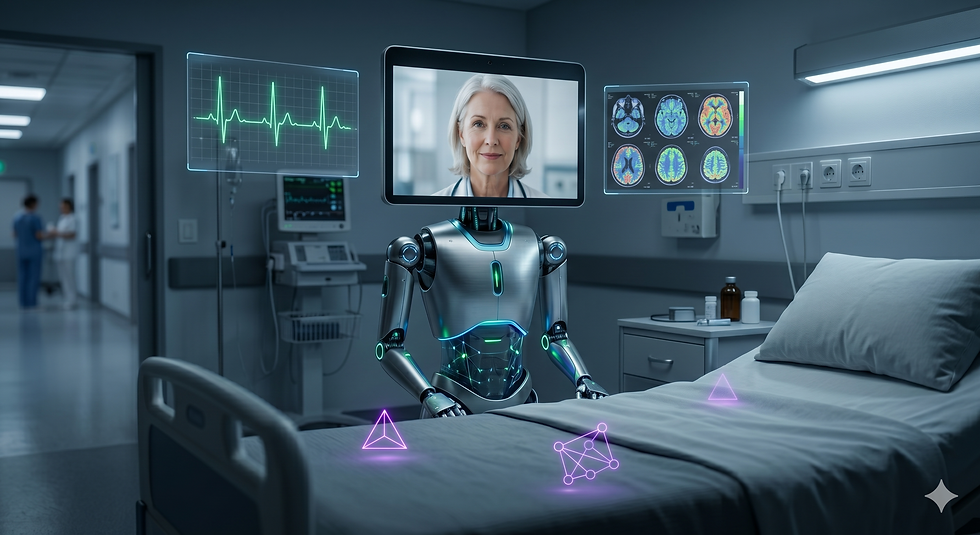
What sort of extremes are going to appear there that we may have to delve with. That was one. And the other one was, of course, these telehealth doctors, screens, robots, whatever you may call them, are becoming more and more present in more hospitals, clinics, doctors, offices. And of course, there's some stuff that's concerning about that, So grappling with it. But I think the big premise that I had said already from Part one was that it was about a discussion about our biological assets, Our biology really now becoming a new asset class and getting into that discussion. And so that's where we will pick up the conversation this week for part two.
There is something that's very important and is becoming very clear when it comes to health care and technology, And that's really a major shift, I think, in how we view our own health.
And that is to view it as a biological asset. Now, we've spoken about before, authors like Yuval Noah Harari, Whose assertion again is that, know, once our biology is kind of predicted, really honed, possibly manipulated and controlled by outside entities, you know, we're in kind of trouble as people.
But there's this other side of this, what we're really seeing happening right now, which is the importance of our biology as an asset. It's very much a real thing that is happening right now. And I'm not sure if we are speaking about it in the right terms and understanding that. So I wanted to talk about that today.
We have this whole new asset class, right, biological assets. In 2026, what we are seeing is the rise of you could call it bio insurance, For decades, insurance has obviously been reactive, You pay a premium and then something happens and then insurance pays for that. But again, we're gonna see this sort of flipping and changing a lot. And there's two ways that we're gonna see this impact.
And one is these sort of biological scores or biological audits, right? And two is going to be cell banks and the concept of preserving ourselves. And we'll get to two in a bit. So back to one, right? This concept of a biological age audit.
So we're in the world now, our biology is an asset that we actually measure, right? Biological age has moved from just an obsession that biohacks had to now it's a routine for everyone we know, So it was first it was calories, And then it was BMI. And now we're very much interested in all the wear and tear on our bodies and how fast we're aging.
Our biological age is going to be used as a measurable baseline to track how well we are doing.
And it makes complete sense, You think of something like a credit score, Speaks to how you are paying back your debts, right? Speaks to that responsibility, your fiscal responsibility. And if you look at the amount of accidents you have in a car and that impacting your insurance, that again speaks to how well you drive or you don't, your skill level when it comes to driving. So this biological age measure, is going to speak to how well you're physically doing or not and your risk factors associated with that. that's going to be used in ways that we haven't necessarily seen before.
And we have things to measure this so well now, We almost have kind of these epigenetic clocks, these sort of AI driven clocks that will look at things like DNA methylation and talk about how fast our biological clock is actually ticking, right?
And we're not dealing with kind of a once-up audit, right? You see your doctor once a year, even some people two, three years, or periods in time. Now it's just this consistent, continuous longitudinal tracking metric over years and much smaller shorter bursts of periods of time where we have all our data all the time. Not just the big numbers, but your sleep, your nutrition, the kind of food you eat, the stress, the amount of stress you're undertaking, have in your life. Everything else may be really great, but you have a very stressful job and that impacts your biology and that impacts that score, that biological score and that impacts other parts of your life. If your biological age is 45, but you're only 35 chronologically, that's a health alert.
And not only is it an alert, of course, about your health, right? that your ability to recover is weakening, but this will be linked to things like health insurance premiums.
Possibly job opportunities and these things happen, That's why we have laws to protect against this kind of discrimination but when it starts happening at this core level, it's not just about disease Now we measuring your health. What all the laws be of discrimination in here I have no idea but it could it will impact your health insurance premiums. It could impact the job opportunities you get.
It could even impact your lease agreement the way a credit score does, right? All depending on the policies and the laws that come about. But certainly in the interim, as we don't have those guardrails, some of these things may be happening, We speak about these wellness clubs and these wellness living places. I mean...
It's hard not to imagine there'll be a time where they're exactly the kind of place that discriminates, And it's less about the people who want to maybe become healthy, who can live there. It's about those who are already there. It comes about maintaining this awesome, shiny number, right? Biological age number that you have. Yeah, so, you know, forget credit scores biological scores are the next metric of discrimination. How this is going to play out in an aging population with some who are too ill, right? It's too late to benefit from some of the advances in medicine. then you'll have others who are never going to get ill and are going to age so slowly because they got there just the right time to take advantage of all of this.
We see that discrepancy in certain generations already, right? People talking about millennials, aging really differently to previous generations and trying to figure out what that is. So we are gonna see that, you know, and this widens societal gaps even more. I mean, what about airplanes denying entry if you don't meet certain scores, Because it's not just about illness, It's not about we cannot have the ill on board, which airlines already do.
It's about health saying that we only want the healthy on board our plane So there's much less reduced risk for us like we can't turn around or have to call a doctor on a plane I'm not at all saying any of this is right These are the questions and debates that are going to come up All I will say is that it's going to be very important to take care of your health as much as you do your credit score and your criminal record and more important than your education record and your transcripts.
So that's the one element of why we can talk about a biological asset. the other element of that is that we are moving toward a world where you can bank your biological material as well to kind of ensure your health for the next 50 years, So kind of, you know, from bank accounts to cell banks, this whole concept of preserving our youth.
The global stem cell banking market is exploding. It's projected to reach 28 billion by 2035. And it's not just about the growth, right? It's what people are banking, If you've ever heard my husband had his wisdom teeth removed a year, year and a half ago. And, you know, we only found it afterwards, but people were like, oh, you should preserve those wisdom teeth, Because you can use the stem cells for regeneration.
So these kinds of unused biological assets, the ones that we store just in case, command over 90 % of the market share, Families and individuals are starting to kind of view these day zero cells, This young pure ones as a strategic reserve. these cells are being banked not for a current illness, Because you're perfectly healthy, but it's really just bio insurance, It's really preventative. It's almost a form of insurance against any future age-related decline, autism, cerebral palsy, whatever it may be. And so imagine a world, again, a baby's born and you're you know, your cells, start being preserved from that very age at different levels. And as your different organs develop and grow on at different stages, really, really interesting.
We are saving our younger selves to use for medicine later, maybe not the obvious signals, in healthcare, but that's where we hit it now, And so these are some of the things we're going to see. know, closing out today's episode, I just want to say, you know, think about your health. not as the absence of disease, but as an investment portfolio.
Not to just view your health as, I'm healthy and I'm gonna live long and have great health span and lifespan but go one step further and understand that now our health in this world we living in is also our investment portfolio, And it's very clear to see with the amount that people are pouring into those portfolios and the benefits they may start to reap in society from having invested in those portfolios, not in the obvious ways, not just because it's good for your health and longevity and your wellness, but how it might impact other things in society and opportunities and chances and things you get. Not saying it's fair, not saying it's right.
Something to think about, But I think definitely bank it. So bank it, capture your biological assets when they are young and potent. Optimize it, okay. Focus on optimizing those things. You can stress, reduction, movement, sleep, really important. Start optimizing those things now. And start measuring now as well, right? So you know what your biological age is at and what that's looking like. And if you had to be forced to have these kinds of audits and numbers, on your profile, on your resume, that you have a grasp of this. I'm not saying share this data, I'll put it out there, but I think things to think about and for you to at least know for yourself.
I would love to hear your thoughts on this. have you measured your biological age? Have you done a test for that? Are you banking your cells? somebody done this? And what are your thoughts on all this?
Thank you so much for being here and until next time. See you. Bye for now.


Comments