.png)
Robot Rounds and the $1B Middleman: The High-Stakes Future of AI Healthcare
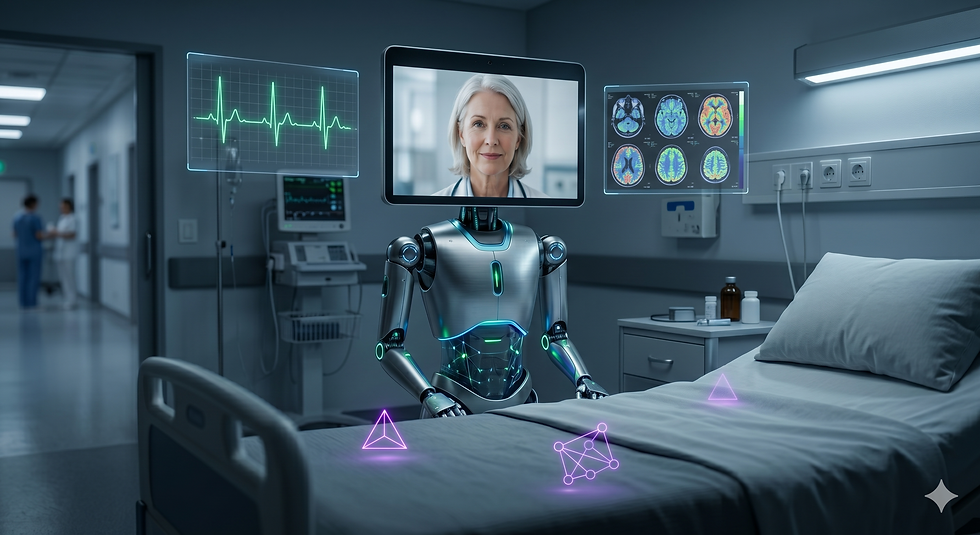
Is the "care" in healthcare being replaced by code? This week, Raakhee analyzes the profound transformation of healthcare driven by AI, robotics, and the rapid proliferation of GLP-1 medications. She talks about the explosive rise of MedVi, the AI-driven startup that turned $20k into nearly $2B by streamlining access to GLP-1 drugs. We also dive into the controversial rollout of telehealth robots in ICUs. While these tools solve staffing shortages and bring specialists to rural areas, they also raise terrifying questions about medical liability and the loss of human intuition in critical care. She examines the tension between extreme efficiency and the essential human "care" component of medicine.
BETA IMAGINATION LAB - Call for Participants
A final call for the last spot (maybe two) in the Beta Imagination Lab! A free opportunity to help you reinvent your career through behavior science, strategy, narrative psychology and futures work.
Learn more and apply below, by 30 April 2026:
The Pharma Acceleration: GLP-1s and AI
Raakhee notes that we are only at the foundation of a massive surge in drug availability and pharma growth.
Business Development at Speed: AI tools allowed one startup, MedVi, to go from a $20,000 investment to 300 customers in its first month in 2024. By 2025, it generated $401 million in sales by acting as a telehealth middleman for GLP-1 weight loss drugs.
Drug Discovery Partnerships: Major pharmaceutical companies like Novo Nordisk (makers of Wegovy) are partnering with OpenAI and Nvidia to use AI to analyze data and bring treatment options to patients faster.
The "One Pill" Future: Raakhee anticipates a future where nutritional intake and health maintenance are reduced to highly efficient, micro-specialized pills, though she questions how this will impact our cultural relationship with food.
Telehealth Robots: The New Bedside Manner
Telehealth robots are moving beyond COVID-era experimentation into global rollouts, specifically to address specialist shortages.
OhmniCare Systems: Some hospitals in North Carolina now use the OhmniCare robot—a 21-inch high-definition display—to facilitate remote "bedside rounds" for specialists who cannot be physically present at every location.
Mobile Diagnostics: Research has shown that radiologists can diagnose x-rays and scans on an iPhone with the same accuracy as a high-end hospital workstation.
The Efficiency vs. Profits Debate: While these tools cut transportation costs and allow specialists to see more patients, Raakhee questions whether the savings will benefit patients or simply increase hospital profits.+1
AI Healthcare and The Critical Human Element
The episode raises a "philosophical quandary" regarding the limits of virtual care.
Human Reassurance: Raakhee emphasizes that "care" requires physical presence, which builds trust and provides human reassurance that a virtual screen cannot fully replicate.
The Risks of Remote ICU Care: A tragic case is cited involving a 24-year-old student who died in an ICU overseen remotely by a tele-doctor. A lawsuit filed by the family highlights the danger of using robots as a "Band-Aid" for severe staffing shortages in critical, life-or-death environments.
*Disclaimer: The text in this post is AI-generated from an original video podcast - applicable data sources, references and/or the episode transcript are provided below.
------------------------------------------------------------------------------------------------------------------------------------------------------------------------------------------------------------------------
Selected Links:
Metz, Cade. "The Billion-Dollar AI Health Startup You’ve Never Heard Of." The New York Times, 2 Apr. 2026, www.nytimes.com/2026/04/02/technology/ai-billion-dollar-company-medvi.html.
Field, Hayden. "Novo Nordisk Partners with OpenAI to Use Generative AI for Drug Discovery." CNBC, 14 Apr. 2026, www.cnbc.com/2026/04/14/novo-nordisk-openai-ai-drug-discovery-healthcare-nvo.html.
"OhmniCare Mobile Telehealth Robot." OhmniLabs, 2026, ohmnilabs.com/products/ohmnicare-mobile-telehealth-robot/.
Hylton, Conor. "How Telehealth Is Saving Lives in Rural ICUs." CNN Health, 9 Apr. 2026, www.cnn.com/2026/04/09/health/telehealth-icu-conor-hylton.
CyberNews. "North Carolina Hospitals are Deploying the OhmniCare Telehealth Robot." Facebook, 12 Apr. 2026, www.facebook.com/cybernewscom/videos/933661552840331/.
Pearson, Catherine. "Doctors Use Smartphones to Make Good Calls on Diagnoses." Voice of America, 28 Oct. 2009, www.voanews.com/a/doctors-use-smart-phones-to-make-good-calls-on-diagnoses-79425187/416453.html.
Sausser, Taylor. "Telehealth Bill Heads to Governor’s Desk." North Carolina Health News, 2 July 2015, www.northcarolinahealthnews.org/2015/07/02/13236/.
Episode Transcript:
Horizon Shift Lab (00:00)
Welcome back to another episode of Signal Shift with me, Raakhee
Last week I spoke about our beta imagination lab, asking people to apply and we've had a incredible response in terms of the caliber of participants we were looking for. So we're almost close to filling our group. have possibly one maximum two spots left, if that is something that sounds interesting and exciting to you, definitely think about it.
You will get to use tools from futures thinking and foresight, as well as great neuroscientific tools and great psychological tools to really go through a process and a journey of reimagining work and career To really understand your skills in a very different lens and it really starts to imagine the work you're going to be doing in the future it's a lot of imagination and play. It's fun. It's intense. You know, there's a lot of work to do and a lot even for four weeks. but it's just the right amount of time to make some amazing discoveries.
I find even in the world we live in now, people tend to have these blinkers, right, and constraints and can only see this in terms of what's out there. Yes, AI is going to impact jobs. It's going to take away a of jobs. It is also going to lead to all kinds of new careers. And I think people don't have a great handle on that. So we're going to bring forth some of that data. We're to help you understand how to analyze and assess and predict what's coming next. So you give me a couple of steps ahead.
The details will be in the description box.
Get that application in soon, we will probably be wrapping up that process towards the end of next week. Okay, so I hope it's something you consider and I'm very excited about that and the cohort of people that are going to be in this Beta Imagination Lab.
There's so much to talk about the future of healthcare and the transformation that AI and robotics will have on the industry. we also have this very interesting time where so much is happening in this space with AI, but it's also coincided with the rise of things like GLP ones, right? Ozempic, Ro, whatever, you name it. There's so many brands now.
I think the groundbreaking, exciting, the hope-giving part of AI really is in healthcare where hopefully it'll come to that point where it really does revolutionize our health, where diseases or large, a lot of them, can become history, right?
That's a very hopeful utopian view of how things might play out over the next few years.
I need to split the episodes into part one and part two, and I will release part two next week this is part
Dig into the first signal, right? One of the most transformative ways that AI has actually supported GLP-1s, know, speaking of GLP-1s, is through getting one startup to go from business development to the market in just two months.
You may have seen the headlines around it, right? Matthew Gallagher, right? Within two months, this was in 2024, he only had $20,000 and he just used a good few AI tools and launched his startup, It's called MedVi, telehealth provider of GLP-1 weight loss drugs.
He got 300 customers in the first month. The second month it grew to thousand, by 2025 the company had generated 401 million in sales in the ad track for 1.8 billion in sales this year. And you know, it's not that AI has supported anything in a medical development sense, right? Or that MedV has even produced a drug.
They are just capitalizing on being a middleman and getting a drug out to people. But what it is and what the signal is about and what this is about is that this is a tale of how pharma is going to grow, how they are going to be able to get more drugs out to us faster. And if we think we've seen the height of supplements and wellness clinics and longevity polls, I don't think we're close to the peak. This is the foundation. We're still at the beginning.
That's going to grow a lot more. Other things that are pointing again to this and we're seeing this happen, Novo Nordisk, they are the makers of Wegovy, Are partnering with OpenAI for drug discovery. Words from their own spokesperson in their Danish company is to bring new and better treatment options to patients faster.
So ultimately using AI to analyze the data, come up with new drug ideas, reduce the time it takes for that medicine to ultimately get into our hands, right, is exactly what all these companies are working on. Now, Novo already has other big AI initiatives, including one collaboration with Nvidia, right, to use sort of sovereign AI supercomputer that they have to accelerate, again, drug discovery efforts. So they're really creating AI models and agents that are gonna help with research, clinical development, that kind of thing. it's very clear that this is a priority right now. And it's a lot of competition between the companies, right? You've got Eli Lilly in the US.
And then you have this band of companies like MedVi who just, again, are just coming in and changing how the market operates as well, right? But changing in the sense that again, it simply means more drugs getting to us even faster, faster approvals, faster timeline, more and more and more.
So, you know, there's a notion we've spoken about before, right? Which is, there be one pill a day so that I don't feel hungry, I don't need to eat, I just feel great and I'm healthy? ⁓ It doesn't seem so far away, does it? I mean, we already spoke about a company who's doing it right now. It was a whole handful of pills you have to take to get your nutritional intake, right? So it wasn't feasible, but the fact is that, you know, in time that'll easily be reduced and reduced down to one pill
And I think when this does happen, I don't think it's too far away and I think it won't be considered ridiculous anymore when we get there, but we'll call it efficient as we tend to do with these things around longevity, weight loss, diabetes, and so many other diseases. But I do raise the question of how are we relationship with food will fare I don't get a chance to talk about this here, but this is something I'm very passionate about. And Sue and I would often talk about food in our signals. And I've actually written a book about this that I to publish real soon, but it brings me back to this notion of our relationship with food.
And boy, that's going to be very interesting journey because we are swinging across extremes, right? One is kind of no food needed, right? Like one pill no food needed, don't even think about food and kind of one pill or stuff yourself with no impact. That's okay. And you need the sound like good options to me. They just sound exactly like that, like extremes. And we are becoming a society with a lot of extreme things happening. So it's something to watch there, right? We're going to see lots and lots of operational change and efficiency in healthcare. And I mean, a lot. It's really not even a question anymore of how much tech, right? That's not the question. The question now is how much human is needed in healthcare.
Make no mistake, in this industry in particular, it is needed. The human is needed in the healthcare. That's the care part of it, right? It's the human part. But how much? I mean, I don't know. Is it robot doctors and human nurses? Is it human doctors and robot nurses? I don't know what that equation needs to look like,
So this leads us into our second signal, which is telehealth robots. And these are becoming very popular and lots of rollouts increasing around the globe, really. And it started as early as COVID when there was a need to do this. And so there was some experimentation with them. And now it's really just easier and so much faster to get that happening some North Carolina hospitals, using a system called OhmniCare.
telehealth robot, And it facilitates these remote consultations, especially when it's like specialists who are not generalized doctors who can just give generalized advice, but they're specialists who can't be everywhere at once, right? And kind of virtual bedside rounds when it's just to check in on, you know, where patients act before leaving and just in the healing process, And of course they've done it really well, right? It's high-definition video. It's a big... 21 inch display.
So it allows physicians who really not on site to have this face-to-face time and to provide clinical care, but not worrying about the transportation, right, of getting from one place to the next, which, you know, doctors do struggle with between different clinics and that sort of thing, right, or having their physical presence if it really isn't needed and they're not needed to be there. This isn't dramatically innovative. That's not what this is. It's quite a simple concept. Like I said, it started from COVID already Some even say that the US is a little bit behind in terms of this, because in a lot of places where you have rural villages, you have remote areas,
It's exactly what specialists have been doing, right? in remote clinics in a native village in Alaska, they've been using telemeds since the 70s, In the developing world, again, a similar thing, right, is.
People may not have computers, but everybody has a smartphone. So doctors would do things like x-ray consults via smartphones. X-rays and other scans are now recorded digitally, rather than to film.
And looking at scans, using your iPhone is accurate. They have compared the accuracy of radiologists looking at these scans on the phone versus looking at it on a large computer workstation in the hospital. And the evaluation of the images on the iPhone matched the accuracy and the diagnostic ability when it was done on a computer workstation as well. So you can read data off of the phone.
Okay, so in many senses, this has been happening, this already happens, it's nothing new, it's not dramatically innovative, but we're gonna see more and more more faster. Unfortunately, we have the system, right, of a doctor's time equals lots of money. because of that, hospitals will take up whatever means necessary to cut those costs. Now, that almost sounds optimistic in the sense that, well, maybe that'll make healthcare cheaper for us.
I think that remains to be seen. Is that going to make it cheaper for us or is it going to put more profits in the hands of those who own hospitals?
The good of this, of course, is that doctors often can't make all these rounds in a timely manner or they can't spend enough time with patients, right? Because you only have to build in the time to move around, get around, especially if you're getting across multiple departments, units, or buildings or going from one location to another. And this can really help.
In those kinds of cases, especially like we said for specialist physicians who are rare and there aren't many and have to consult in more than one space and in rural and in underserved communities to give people access to just more qualified physicians and also those more specialized doctors. And then there's areas where it makes complete sense, like dieticians, so virtual dieticians. course, virtual therapy has been going on for the longest time.
And it's extremely useful, effective, not only that, it's a very normalized part of how people do therapy these days, right? So it's not, the expectation is not that when you're seeing your therapist, you go to an office, right? That's not our only expectation anymore, but where do we draw the line and say that this has to be a human function? So the way this gets concerning, right? you know, there's always, there's a reason why.
A doctor needs to see a patient, right? So even if you are in post-care and you're just healing and something could crop up that a doctor or a nurse cannot pick up via a screen. And yes, even with monitors and sensors and all this data, it might be very rare that that does happen, but there is still always a possibility, right? It's why you can never truly diagnose unless it includes the actual live physical assessment, not just your bloods and your data.
be one simple, small little thing that has to be picked up by the eye and the eye present in the room, And so that's, course, you know, concerning part about this. There's another part of this that is for anyone, right? If you've been in hospital, if you've visited or had somebody in hospital.
one of the most reassuring things, even when it's the smallest procedure, but if you are staying in hospital, even if it's just as an outpatient or for a night, one of the most reassuring things is to see either the highest level of nurse who's going to come speak to you or your doctor, will come and see you and not just you, but sometimes your family even. And it's not just about the information. It's not even about the assessment. It's nothing about that.
What it's about is human reassurance. It's the trust that you can only come across in physical presence, right? Physical presence is needed for that. And I mean, well, virtually I would get some of that, but not all of it. wouldn't be the same. And that's a very important part of that word care, right, in healthcare.
Now, we're gonna have these sorts of situations crop up, right? Like the situation where a family is now filing a lawsuit after their family member died in the care of a telehealth ICU doctor. This is a University of Connecticut dental student, right, who died in an intensive care unit. that was being overseen remotely by a tele doctor.
And so the family of course filed a lawsuit, He was just 24. He had abdominal pain, and I believe it was alcohol induced pancreatitis, intense dehydration and you know, he was in the ICU. This was a high risk case. apparently it was staffing issues that prevented this constant and consistent care when he was hospitalized
The important thing to remember here is that, you know, it's not the technology, right? It's how it's deployed. And what are the guardrails? I mean, why does an ICU have a telehealth robot?
I can totally understand use cases where it makes sense, right? But not in an ICU where we know it is critical and the smallest thing is life or death, right? Early health robots suddenly cannot be the bandaid to every staff shortage, you know, because they don't, they will not cut it to that extent, the oppositional question of course is,
Was it better than having nothing at all? So is it not better than having no care at all or simply sitting around to die in a waiting room? is the issue the bigger problems that surround health care. And that's absolutely a fair perspective as well.
It's all very experimental. And it is a little scary because it's experimental with our lives. choose your hospitals carefully where you have the power for all kinds of reasons, right? From the cost of medical care to these sorts of things now. I would really understand the sort of technology that your hospital is deploying and your doctors as well and what their approach is and how they're gonna be experimenting over the next few years because this directly impacts your life, So I think it's really important to know that.
On a lighter note, I will add, as I was doing my research on these stories and reading up about it, someone made a funny comment online that I just had to share. And the comment was, I once said, imagine somebody goes into a coma in the last year or two, and this year or next year, they wake up out of the coma, but they see either a proper robot or these telehealth screens come up to get them out of the coma. They'll kind of think they're waking up in 2050, right? And they're not, it could just be six months from when this happened to them.
It's just funny because it speaks to the pace of all this technological change that we are in and we are going to see rapidly specifically in industries like healthcare.
What are your thoughts on all this? What's your thought on a telehealth ICU doctor? And how would you feel if... Yeah, you were in that situation. know, what is happening with the clinics and hospitals and doctors in your area where you stay? What are you seeing happening?
So, either ways, thank you so much for being here and until next time. Bye for now.


DH88 mình mới lướt thử vì thấy bạn bè nhắc hoài, kiểu tò mò xem trang trông ra sao thôi chứ không có thời gian ngồi nghiên cứu kỹ. Vào cái là thấy giao diện khá sáng sủa, chữ dễ nhìn, kéo xuống không bị rối mắt vì họ chia nội dung thành từng khối rõ ràng. Mình có đọc lướt phần giới thiệu thấy họ để thông tin giấy phép PAGCOR với chứng chỉ GEOTRUST ngay trong bài, ít nhất là nhìn cũng đỡ cảm giác mập mờ. Mấy mục trên menu đặt gọn, bấm qua lại cũng nhanh, không bị giật lag gì. Nói chung chỉ xem sơ sơ mà vẫn nắm được ý chính nhờ tiêu đề…
tylekeo.design hôm bữa mình vô thử vì thấy mấy đứa bạn nói chuyện kèo kèo suốt. Mình cũng không rành cá cược gì đâu, chủ yếu xem giao diện với cách họ viết cho người mới dễ hiểu không. Lướt qua thấy họ để mấy tiêu đề kiểu “kèo bóng đá là gì” với “tỷ lệ kèo” khá dễ nhìn, nên đọc nhanh vẫn bắt được ý chính. Có đoạn giải thích tỷ lệ kèo là con số thể hiện khả năng xảy ra của một kết quả trong trận, đọc kiểu gọn gàng chứ không dài dòng. Mình thích nhất là chữ chia đoạn vừa phải, nhìn không bị ngợp, kéo xuống là biết đang ở phần nào nhờ…