.png)
Civic Imagination, Connection and Care for a Future Worth Inheriting
Updated: Feb 24
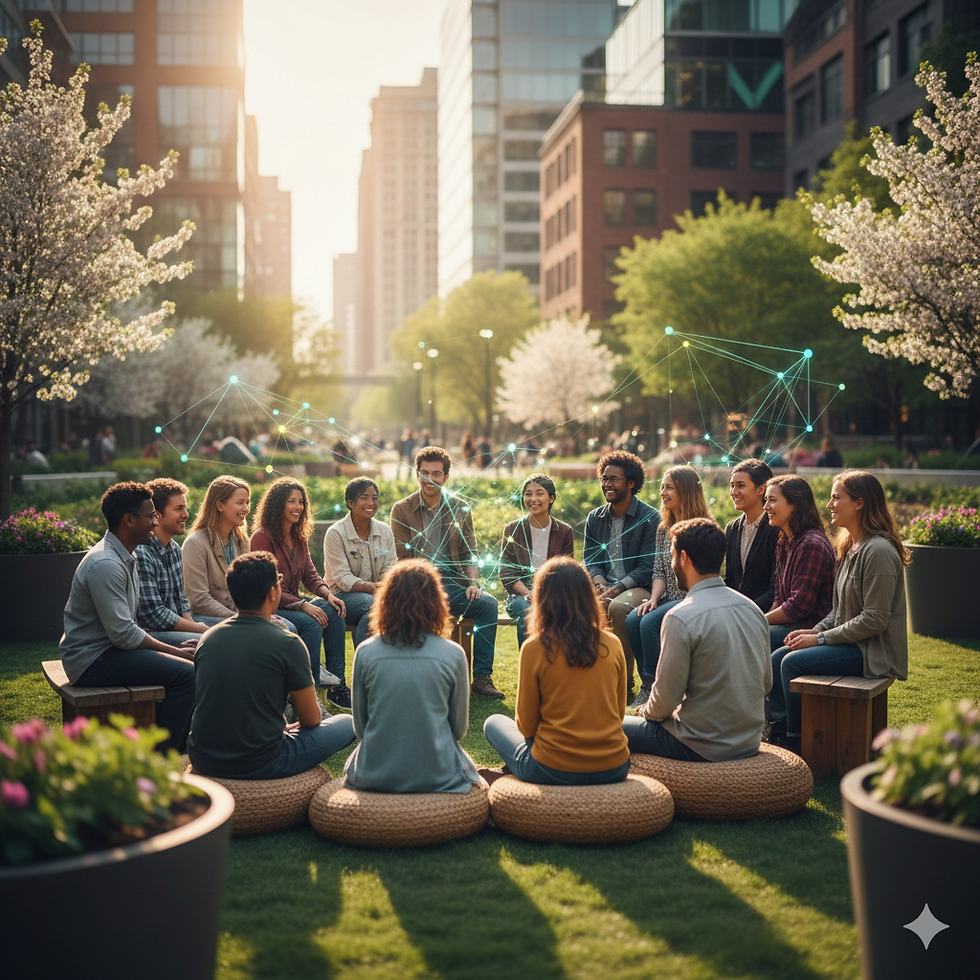
In this episode of Signal Shift, Raakhee interviews amalia deloney, a relational futurist and strategist who specializes in civic imagination and community-driven transformation. The conversation highlights a global shift toward localization and the prioritizing of human relationships over digital obsession.
Where to Find amalia:
The Role of a Future Strategist
amalia describes her work as a blend of legal expertise, community advocacy, and futures thinking.
Institutional Reimagining: She uses her legal background to navigate complex systems while applying futures methodologies to redesign them for social change.
Vocabulary and Tools: While her core mission of community-driven problem solving remains unchanged, her training has provided a specific vocabulary and methodology to share futures tools with others.
Shift in Timeline: She observes that community organizations are often trapped in three-to-twelve-month "grant timelines"; her work invites them to imagine 30-to-40-year "generational visions" instead.
Civic Imagination: Collective Human Visions vs. Digital Futures
Through her 2025 "futures interviews" with diverse individuals, amalia identified a striking gap between professional foresight and lived human desires.
Common Values: Across all demographics, people’s "futures worth inheriting" were rooted in care, love, reciprocity, and neighborliness.
The Absence of Tech: Notably, neither AI nor digital technology appeared in these personal visions. Instead, participants focused on social technology—the quality of human-to-human interaction.
Nature as Infrastructure: Every single conversation amalia conducted featured nature (water, trees, parks) as a prominent, grounding element of the future.
The Future of Cities: "Looking Out"
amalia suggests that the "posture" of cities is shifting away from traditional hierarchies.
Highly Networked Communities: Instead of looking "up" to governing bodies for solutions, resilient cities are learning to look "out" to marshal local resources and solve problems together.
Micro-Connections: Change is increasingly happening at the "block-by-block" level, where trust and mutuality are built between neighbors.
Multi-Local Belonging: amalia highlights people feel kinship in multiple places simultaneously without a hierarchy of belonging.
Navigating Climate Migration
The conversation concludes with the reality of climate migration, which amalia notes is often underestimated because it occurs on a micro-scale.
Micro-Scale Displacement: In cities like Baltimore, climate migration isn't just about melting glaciers; it's about specific neighborhood streets that will be underwater within the next decade.
Anticipation Without Overwhelm: amalia views futures work as a tool to help people "lean into uncertainty" and build the muscle memory needed to anticipate these shifts without becoming paralyzed by them.
*Disclaimer: The text (above) is AI generated from our original video podcast - please see below for the full transcript.
------------------------------------------------------------------------------------------------------------------------------------------------------------------------------------------------------------------------
Episode Transcript:
Raakhee: (00:00)
Welcome to Signal Shift. Happy Lunar New Year. It's our reset opportunity and I think we all really need it. Today I'm speaking to a future strategist who also happens to be a friend, amalia deloney a very warm welcome to Signal Shift.
amalia: (00:17)
My gosh, thank you. I'm so excited to be here.
Raakhee: (00:19)
So happy to have you here. Let me tell you a little bit about amalia. amalia is a nationally recognized future strategist with more than 25 years of experience in shaping public policy, philanthropy, and community-driven transformation at scale. Through her practice, Point A Studio, she partners with communities, governments, and mission-driven organizations to design futures worth inheriting. Her legal background allows her to understand the complexities of institutional systems and her futures thinking allows her to reimagine them.
What a time. And yeah, gosh, amalia, we need you in this world. amalia is a 2024 Futures Fellow with the Association of Professional Futurists and has held fellowships with the Berkman Klein Center at Harvard University, New America, among several others. She describes herself as a civic imagination leader.
And I'd have to share with everybody, it wouldn't be fair if didn't, amalia was involved in HSL in the very, very beginning stages before we became a company, before any of that. From a community perspective, we kind of all work together. We studied together at the Institute for the Future. And so as I described to she's definitely a friend who's doing some amazing things and we are going to get to learn about that today. So yeah, where do we begin?
amalia: (01:42)
It's just such a homecoming to be talking to you and to see how far Horizon Shift Lab has come because I remember the mural boards thinking of names and you know, it's a real thing and you guys are making shifts in the world.
Understanding that in some ways our whole life had been futures making, right? I feel like that realization that emerged during the IFTF training is really still present with me and I think the opportunity now is to work with other people in community who feel that as well, who actually carry within them, ancestrally and in the present, real clear ideas of what they want for themselves and their communities, but haven't been invited into conversations to be able to share those visions in such a big way or more importantly such a long way, right? They're often asked to give like bite-sized versions of the future, but not talk about the 30-year vision that they have.
Raakhee: (02:46)
You're doing some interesting things. You've of course at the fellowship, you've got your studio and you're doing an amazing master's program right now. I think everyone fairly has this question. What is the daily life and work of a fugitive strategist?
amalia: (03:00)
It doesn't feel so different from what I've always done. I think what feels different is that there's a vocabulary around it. And more importantly, I feel like I have a community of practitioners that I can turn to. I think that whether it was in law or community work I was doing before or working in philanthropy, this sense of wanting to engage with problem solving and think about how you develop solutions with community at scale and how you oriented those solutions from the very beginning towards social change. know, none of that's changed. That's, all sort of part and parcel of what I do now. I think what I appreciate now is the methodology to be able to talk to people about the different tools.
And I think being part of the APF community has just also introduced me to so many people across the world who are really engaging with futures in traditional ways, but more often than not. new and exciting and kind of radical and boundary pushing ways that people are thinking about the future and that's amazing.
Raakhee: (04:17)
one of the first questions was basically, you tend to work with communities and I mean, that's where change has to happen, right? With communities, with governmental organizations, with nonprofits.
It's considered maybe, maybe that's an old way of thinking, but considered tougher sort of areas to work in to implement change, right? Either considered archaic or there's a lack of funding or any of those sorts of challenges, right? And then you talk about imagination in these spaces, which is also so radical because it's often about we have to do what's needed right now. So I think getting leaders in these spaces to think about the future and then to... bring this radical idea of imagination and imagining different. How do you achieve that?
amalia: (05:01)
I wish that was an easy answer. I think it is true people who are doing community work right now are incredibly challenged, you know, without a doubt. There's so many compounding and mitigating factors. you know, period, full stop, it is hard work. And I think that when you're able to work with community in a one-on-one way, and you create the space for them to have the container and the time to be able to engage in conversations that are about a longer timeframe, people have a lot to share.
And it has been, it's my experience that it's not that they don't have those answers, they have the answers, but that sort of the structure of the nonprofit world, the structure of the challenges people face in communities, the compounding challenges of fundraising and organizational management and all of these things keep people in a timeline where three months, six months, a year.
Really feels like luxury, you know, and that's often what I find in communities. Like when you add, when I first ask people like, what does the future mean to you? It is very typically associated with a grant deadline. So like a one year or a two year grant, maybe a midterm election. But these are sort of imposed timelines that they've been taught to operate in versus saying, let's start with a generation or let's call to mind a child that you care about right now who's very young and imagine that child's child. And people can go there in an instant. They're just not ever invited to.
Raakhee: (06:50)
Speaks to the importance of having you in these spaces, right, and leading these conversations. And I loved that example of a child's child, right, and bringing it really home and really personal for people, because then it gets real.
amalia: (07:05)
50 years, 30 years, 20 years, even 10 years can feel like a long time until you help people anchor what that time period feels like in a visceral way. you know, five years ago was COVID, people feel like, that was yesterday. You know, maybe how many years has it been since you graduated from high school? How many years since you learned how to drive a car? How many years since you, you know, X, Y, or Z? I think when you give people ⁓
This kind of the narrative that frames five years, 10 years, a decade, 20 years, and then you move it forward, people can see and feel that that future isn't very far off at all.
Raakhee: (07:48)
Yeah, exactly. Five years is nothing, ten is nothing. I know in futures work we typically look at 10-year timelines and even that feels so light now, right, with the extent of accelerated change the world is making.
amalia: (08:03)
It's February 2026 and I feel like I've talked to so many people already who feel like they've lived three lifetimes since January.
Raakhee: (08:11)
Totally. thank goodness there's another reset because yeah, or some reset, some symbolic reset, right? Doing this kind of work, I guess, how do you,
I mean, I think two parts to the question. One, what are some of the patterns or macro trends? The more logical things you could talk about in the world, and I think we all see them, but I think it's, again, as a futurist, you might have things on your radar that we don't, right? that's one part of the question. And the second part is How do you feel about like, yeah, what are your worries? What are you excited about?
amalia: (08:44)
Coming out of the Association of Professional Futurists Fellowship. One of the things I did was set up a sub stack like everybody in the world. I was late to the game, but I set up one and it's called Seed and Signal. And I did it because through the fellowship, I really got back in touch with my sense of joy around writing you know, when you're writing for no audience but yourself, you're just writing because it helps you make sense of the world and because you have something that you want to share. it sort of didn't matter if anyone read it except my mom, I think, who was my first subscriber.
But through the process, I started doing these futures interviews because what I realized is that so many of the conversations I was in the future space, I was with, you know, people who were professionals or experts, whether that was through years of practice or through a degree or certification. And because my practice has always been community-based, I knew from experience that lots of people, everyday people have strong and compelling visions of the future. And so I wanted to talk to them.
So last year I did 21 conversations with people who ended up being from all across the country, asking them about visions of their future and people can read about this online. But I think to your question, what struck me at the end of the year was when I looked back and realized that like across age, across race, across gender, across geography, everybody wanted the same future, you know, and these were futures where the same words kept coming up, care, forgiveness, love, reciprocity, mutuality, neighborliness.
It's just like the same words kept coming up. And I was talking to people from very different parts of the globe, very different life experiences, all of the things. And yet everybody, when they imagine the future 30 and 40 years out, a future that was worth inheriting, it was one that was really rooted in love and care.
Give me a future full of care. Give me a future where I can make mistakes and I'm not thrown away. This is what they're saying. They weren't asking for complex policy about workforce development and co-housing and ADUs and all of these other things. And I think I really ended 2025 and went into 2026 feeling like that gap has to be closed and that the people on the ground who have very simple but actually quite complex and nuanced visions of the futures are the futures that we need to be with.
So striking to me, like how out of alignment things are, is like the whole conversation around AI, right? Like, you know, that we need ethical AI for sure. We need to understand how to collaborate with AI and we need to know how to use it and we need to leverage it. And, you know, like there's this whole kind of level of conversation that's really around understanding AI, mitigating the harms, working with it, harnessing its power, but it works from an assumption that it's sort here to stay. And then on the other hand, when I'm actually talking to humans and asking what kind of future they want, AI doesn't even come up. And it's not just AI doesn't come up, technology doesn't come up. The kinds of, or rather I should say digital technologies don't come up.
Yes, people are talking about technology, but the kind of technology they're talking about is social technology, human to human interaction. How am I in place with other people, getting to know them on a human level? The kinds of futures they describe always include nature. I didn't have one single conversation where nature didn't play a prominent role. And it was people remembering water and a certain tree and a park and a backyard and the sound of a bird. So the futures that people are describing are not digital futures. They're very human. They're very emotional. They're very grounded in place. And they're very informed by culture.
Raakhee: (13:07)
This has come up in so many conversations recently, it's so ironic, right? If we have tech and AI at the level it is going to be at, we don't have jobs. And if we don't have jobs, we don't need to use the tech, why do we need the tech?
And I think those are the questions that people sit with then is that we created a world where we need to sit in front of a screen and we won't need to sit in front of the screen. So what are we doing? in the education sector. know places like Denmark and even in the United Kingdom, Spain.
One, the social media bans, but also things like changing the policies around tech in schools, because now we can see that tech is not helping us learn, right? We need the social interaction with a teacher. take the tech out, take the tech away from us, right? We are losing something.and these ideas coming up everywhere, right? Of like this return to simplicity.
amalia: (14:04)
A trend I've definitely noticed is the number of workshops that are moving to place-based formats.
And I feel like I've seen and heard multiple versions of that where people, they want to go back to the in-person gathering. They may not want to come back to the office full-time, but they want some sort of connection with their colleagues.
Raakhee: (14:26)
Coming back to the basics. And these are basics we've lost because we don't do that on the average day. And now we're almost being forced to kind of rediscover what really makes us human.
Another thing that I was curious about, and you get to see so much of the work you do, cities. And we talk a lot about the future of cities and what's happening with cities and working with different cities and city organizations. this concept of local and localization and smaller kind of being stronger. What do we see around the future of cities?
What do you see in the work you're doing and anything interesting happening there?
amalia: (15:03)
Yeah, I mean, I was on a webinar in early January. I should be able to quote who it was, but I don't remember. But they were basically talking about, particularly in the United States, but really globally as well, that what cities were learning was
they had to change their posture of where they turned for answers. Then for so long, we've all been taught to look up for the answer. And then with all of the turmoil that we're in, you can't expect to look up to the next governing body to solve the problem or to send you resources.
And so what they were talking about is that like the cities of the future have to be highly networked, right? You have to be in this sense making position all the time because if there isn't one straight kind of line or chain of command to look up if you need help, what you need to be able to do is look out, you know, to sense and find the resources that you have within your geography that you can marshal to solve a problem.
And I thought that that was such a interesting comment to hear on a global panel and absolutely mapped onto what I'm seeing in the cities that I work in, right? Is that they have to solve problems that they've never had to solve alone before. And then to get through the problem requires a different shift in your mindset. Instead of waiting for the solution and waiting for the answers, you need to build the solution together with the people around you. And to be able to do that well and to be able to do that quickly requires trust and relationships.
You build the trust, you show up for one another, you demonstrate mutuality and reciprocity. So in the moment when you do need people and you put out the call, they come without question. And I think that's a real shift in cities. It moves things down to a block by block basis. In some ways, like I used to talk about, like my favorite kind of metric of change was the neighborhood level, but I really think it's much smaller than that.
I don't even think neighborhood feels big in some ways now. know, like 5,000 people in 10 or 15 blocks in some ways can feel quite big when you're really talking about micro change, like building level or on the block level or the two streets facing each other or across the alley or one corner around the other corner. I think that these micro connections are really the foundation that everything else is being built on top of now.
There's a level of complexity around micro connections, is the sense of what does it mean to belong in multi-local locations. That what I hear in a lot of these conversations is that people feel a deep sense of belonging and kinship when they can belong in multiple places at the same time and they're not in conflict with one another. There's not a hierarchy of belonging.
You're one whole person that takes up space in multiple places. I feel like that's the complexity we need to bring into this conversation about micro-connections so that we don't fall into an old thinking, which is a micro-connection is a small connection between two or three people that are similar. It can be a small connection with people who are radically connected in multiple ways at the same time.
Raakhee: (18:41)
I think the thing coming up for me is just like we have got to learn to connect on value and realize everything else is peripheral. we almost need to rip away the walls that are very imaginary around other things. And come back to that,
amalia: (18:55)
There's definitely the sense of belonging to each other. I think more complex and nuanced sense of we all belong to each other because we're all entangled in this crazy thing called life That just at a very on a cellular level, we are all bound up with one another. And if we could hold that and understand that everything affects all of us, I think how we would approach problem solving would be very different.
Raakhee: (19:23)
Yeah, so beautifully said. the last big question I had was, so there's the micro level, micro connections going local cities, like the kind of let's huddle together closer. And at the same time, the world is going through this flux of movement and movement of people and migration and migratory patterns that are even a little unpredictable because of multiple factors, right?
And it's not just based on politics and geopolitics. It's climate change. It's the fact that it's AI and what's going to happen to jobs. It's the fact that how we learn and education has to change. Everything has to change. And people are trying to find belonging, right? And in a place where...
You can have a good life based on just simple values, that don't seem that simple and easy to achieve anymore in a lot of places, for different reasons in a lot of places. No one knows where to go, where to stay.
And a lot of people are moving and they're figuring it out.
Curious in what you're thinking about all of this and what you're seeing
amalia: (20:31)
Things are much more precarious now 20 years ago, maybe a little longer than that. There was still a sense that like, you would get a job and you would sort of, it might not be in the city or the town you grew up in, but it wasn't a sense that you were going to, that by taking your first step forward, there were 10 more moves that were gonna come after that. Like it just, that wasn't how things went. You you were gonna stay in a region or if you were gonna move, it was because you really wanted to be in that city or you really wanted to be on that coast. And now I think things are much more precarious.
You know, I think that people, who want to stay in a certain neighborhood, a certain city, a certain part of the country, a certain part of the world often can't, you know, through no choice of their own, whether it's war, whether it's economic conditions, or increasingly, as you and I know from our original class where we met, climate migration.
And so, how do you balance this sort of enjoying life and living it to the fullest and leaning into the uncertainty, which any futurist will tell you, like, there is no certainty, everything is uncertain. How do you lean into the uncertainty as sort of the state of flow that you're constantly in without letting it overwhelm you? And I think that that's a skill set, and I think it's muscle memory that you have to build, and I think that there are tools that help with that. And I do think that if there is...
There's many gifts that futures can give to the world, but I think one of the gifts futures can give to the world is helping people acclimate to a sense of what it means to anticipate without being overwhelmed by it. And I think that climate migration in particular is really underestimated.
We know that the hurricane seasons are more intense. We know on sort of a theoretical level that the glaciers are melting. We know all of those things. I think where people don't see it and are still quite surprised is sort of internal to states, internal to cities. Where I live in Baltimore is a perfect example, the neighborhood I'm in. There will be streets within the next 10 years that are under two feet of water. It's on such a micro scale, we're talking about in a single neighborhood, that I think it's very hard for people to make the connection that that is also climate migration.
I think that these are the kinds of things that everyone should be thinking about and talking about. And the opportunity with, you know, podcasts like this is that, you know, I hope more people join these conversations.
Raakhee: (23:10)
Absolutely. These are great micro connection conversations to have.
amalia, thank you so, much for being here. This was such an interesting conversation. It's probably left people with more questions, but hopefully, think also a different way of looking at things and knowing there's different ways of looking at things, And some really interesting concepts. So I hope you enjoyed this, to everyone listening. And please leave your comments and your feedback.
amalia, thank you so, much for being here. It was great.
amalia: (23:37)
Appreciate the invitation and such a great conversation.
Raakhee: (23:40)
Thanks to everyone listening and we will see you again next week. Bye for now.


Comments